


It’s one of the most frustrating moments a business owner can have. You spent real money on a beautiful website — clean design, professional photography, smooth animations — and then you Google your own business and find a competitor with a site that looks like it was built in an afternoon, sitting comfortably above you in the results.
It feels unfair. It isn’t random. It’s because “looks good” and “ranks well” are two completely different systems, judged by two completely different audiences — and most websites are only built for one of them.
Two Different Judges, Two Different Standards
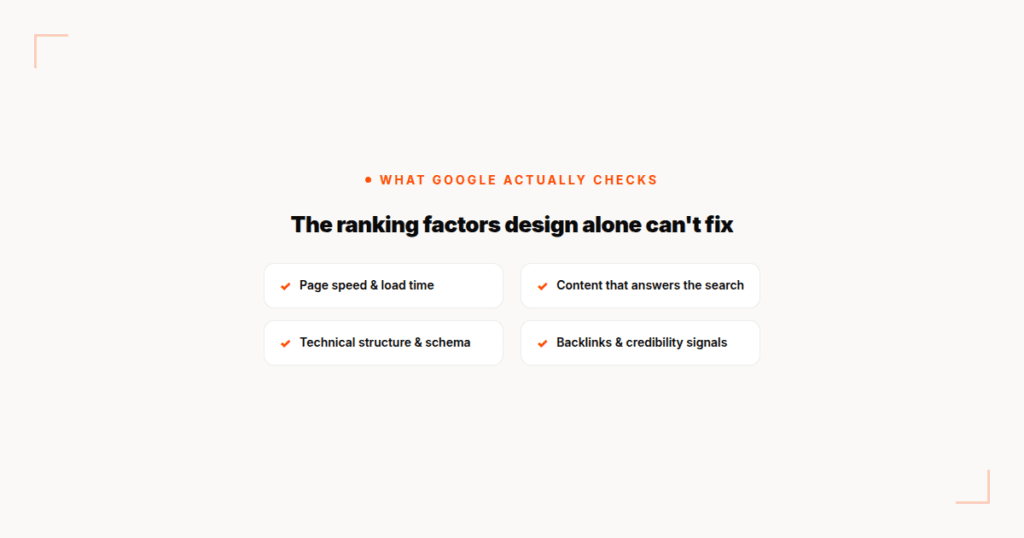
A human visitor judges your site on how it looks and feels in about three seconds — is it clean, trustworthy, easy on the eyes? Google judges your site on something else entirely: can it read the page cleanly, does the content actually answer what someone searched for, does the site load fast, is it structured in a way its crawlers understand, and do other sites treat this one as credible enough to link to?
A gorgeous site with none of the second list checked off will lose to a plain one that has all of them — every time.
What’s Actually Driving the Ranking Gap
- Page speed. Heavy, unoptimized images and animation-heavy designs — often exactly what makes a site “look good” — can quietly tank load times. Google factors speed directly into ranking, and slow sites lose visitors before Google even gets involved.
- Content that actually answers the question. A visually striking homepage with three sentences of vague copy loses to a plain page with a thorough, specific answer to what someone actually searched for.
- Technical structure. Proper heading hierarchy, schema markup, clean URLs, a working sitemap — none of this is visible to a human visitor, but it’s exactly what tells Google what your page is and who it’s for.
- Backlinks and credibility signals. A less polished competitor that’s been featured in local press, listed in directories, or linked to by other sites carries authority a beautiful new site simply hasn’t earned yet.
- Consistency over time. A site that’s been live, indexed, and occasionally updated for five years has a track record. A stunning new redesign is, from Google’s perspective, unproven.
Why This Disconnect Happens So Often
Most web design projects are scoped and approved by looking at a mockup — a static image, judged the way a human judges it. Nobody in that approval process is checking heading structure or schema markup or asking whether the copy actually targets a real search query. The site gets built to impress the person signing off on it, not the algorithm that will decide whether anyone ever sees it.
Design and SEO are often treated as two separate projects, sometimes handled by two people who never talk to each other. The result is a site that wins every design award and loses every relevant search.
The Fix Isn’t Choosing One Over the Other
This isn’t an argument for ugly, purely functional websites. A visitor who does land on your site from search still needs to trust it enough to stay, and design does that job. The point is that design and SEO have to be built together, from the start — not design first with SEO patched on afterward, and not SEO-optimized content dropped into a template nobody enjoys looking at.
A genuinely well-built site is fast, structured correctly, says something real, and still looks like it belongs to a business worth trusting. That combination is rarer than it should be — which is exactly why it’s such an advantage when you actually have it.
How to Tell Which Problem You Actually Have
If your site looks great but isn’t showing up, the honest next step isn’t a redesign — it’s finding out exactly which of the ranking factors above your site is missing. Sometimes it’s one fixable technical issue. Sometimes it’s a content gap. Rarely is the actual fix “make it prettier.”
We’ll tell you exactly what’s standing between your website and the ranking it deserves.