Room service your guests
actually order
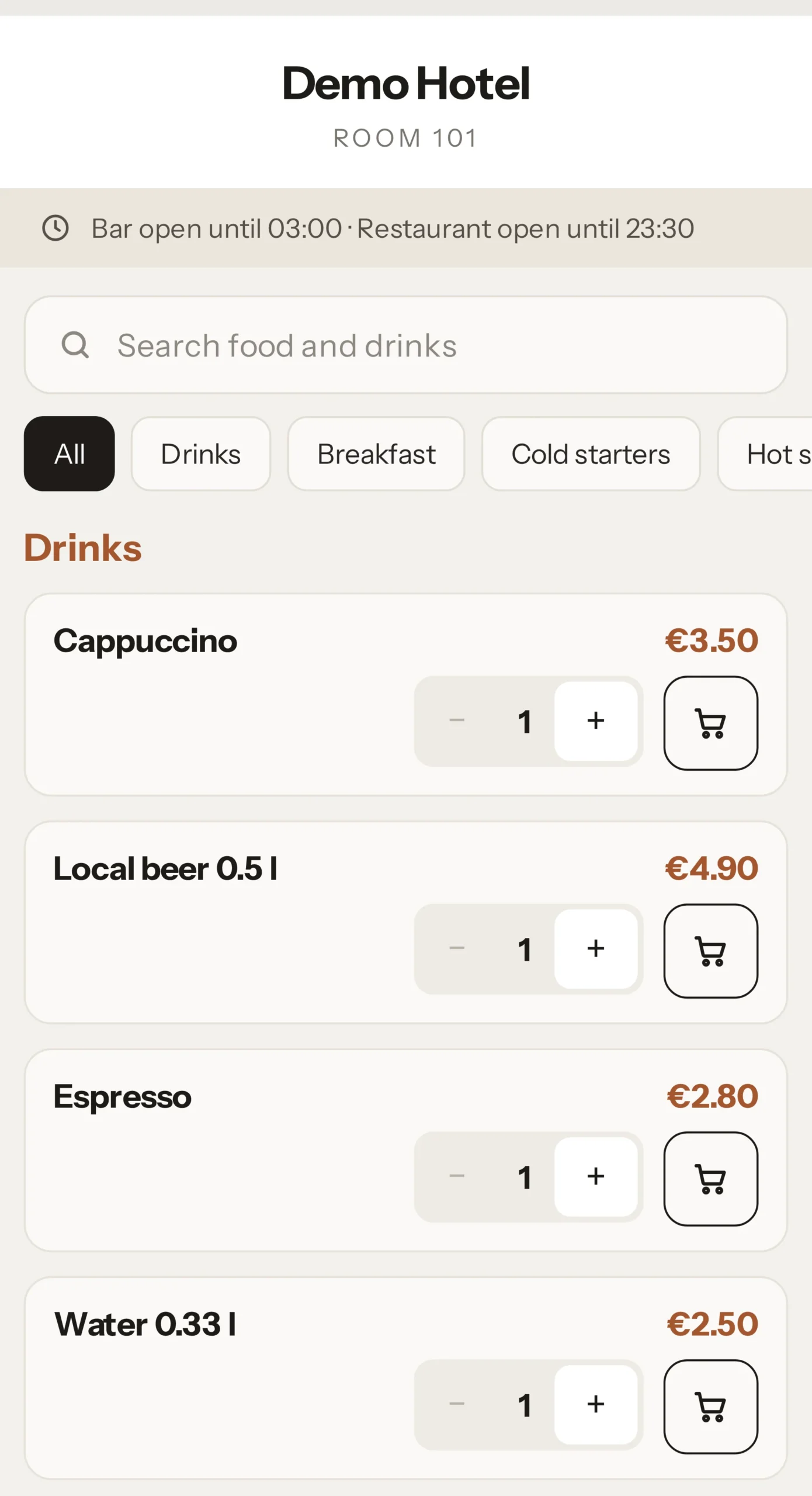
A QR code in the room opens your menu on the guest’s phone. They order in their own language, the order lands on a tablet at the bar or in the kitchen, and your staff accept it with one tap. No app to install, no guest account, no commission to anyone.
Hosted and supported by us. Nothing to install on your hotel’s systems, and nothing to buy on this page — every hotel gets its own quote.
Most room service is lost before the guest picks up the handset
The guest does not know what is on offer, does not know what it costs, and is not sure the person on the other end will understand them. So they order nothing, or they walk out to a café. The hotel then concludes that room service does not pay — when what does not pay is the phone call.
Room Service Now removes the call. The menu is on the screen the guest is already holding, in a language they read, with prices and photos. Ordering takes thirty seconds and costs the guest nothing extra.
How it works
The guest scans
A printed card on the desk or a sticker on the minibar. The menu opens in the browser — no app, no download, no registration, no email address required.
The guest chooses
Photos, prices, descriptions and notes, in the guest’s own language. Only what is actually available at that hour is shown.
The order arrives
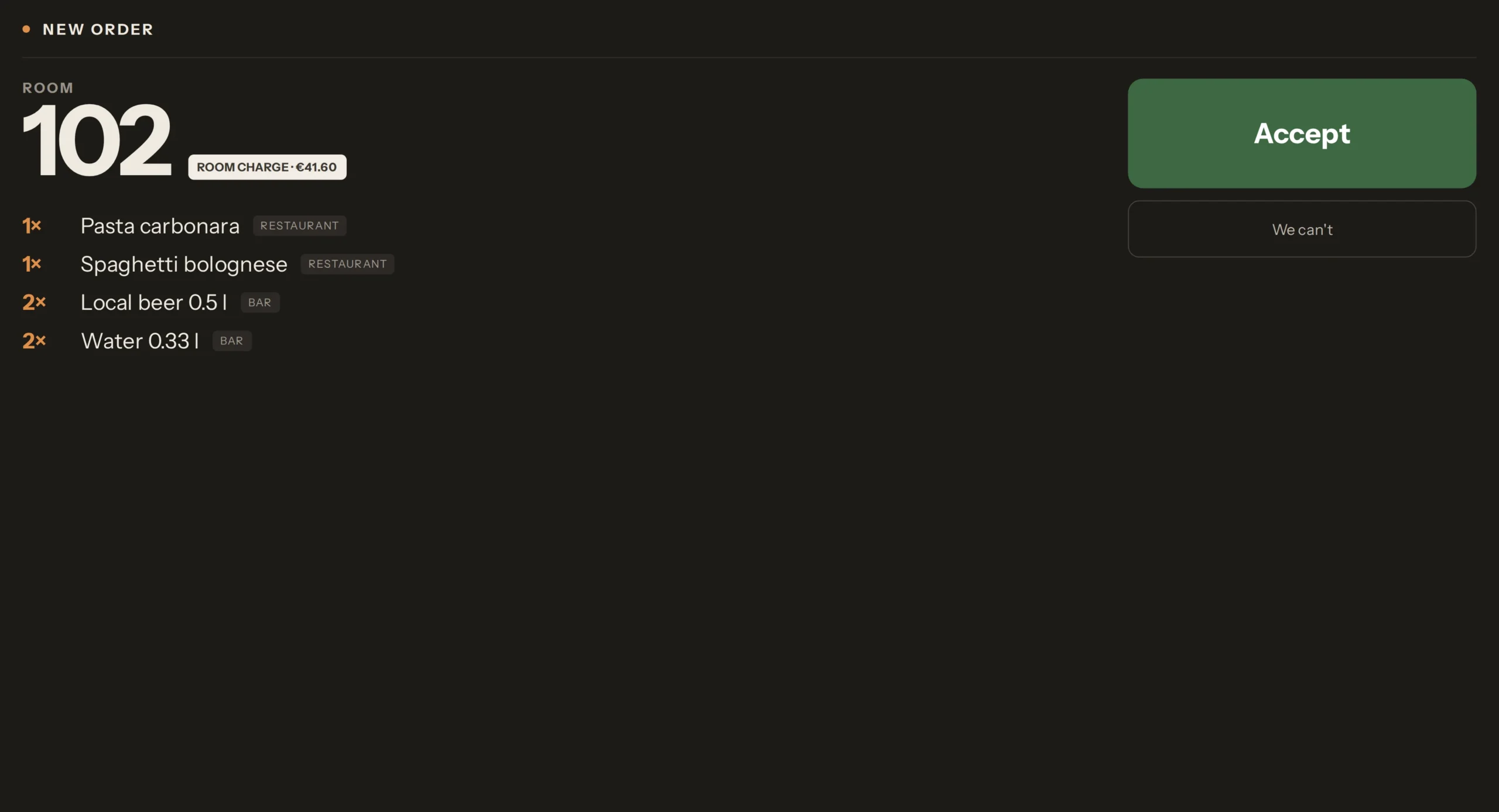
On a tablet at the bar or in the kitchen, with the room number large at the top and an alarm that keeps repeating until somebody takes it.
Staff accept it
One tap. The guest sees on their phone that the order was accepted. The amount goes on the room bill, the way it always has.
Guests have already decided how they want to order
73% of travellers want to use their own phone to manage their stay — checking in, paying, and ordering food. 39% say they want to order room service from their phone rather than call. 49% expect contactless payment as standard.
Source: Oracle Hospitality and Skift, Hospitality in 2025: Automated, Intelligent… and More Personal.
There is a simpler reason too. A menu on a screen sells better than a voice on a telephone — the guest sees the dessert instead of hearing a list, and adds it. Hotels that move ordering to the phone screen usually find the number of orders rises before the average order value does.
What the system does
The room is the identity
The QR code carries a signed token, never the room number in the address. A token can be cancelled and reprinted for one room without touching the other two hundred.
Occupied or vacant
An empty room accepts no orders. Reception flips the switch, or your property system does it. This alone removes almost every way the code could be misused from the corridor.
One order, several destinations
Drinks to the bar, food to the kitchen, spa items to the spa. Each destination sees and confirms its own part. The guest sees one status.
Opening hours per outlet
The kitchen closes at eleven, the bar runs until two. The menu follows, including hours that cross midnight.
Time windows per item
Breakfast appears at breakfast. Nothing a guest cannot get at two in the morning is ever shown at two in the morning.
Languages that are yours
The guest picks their language, your staff keep theirs. Dish names are translated by the hotel, not by a machine — the kitchen always reads the name it knows.
A receiving screen built for a busy bar
Room number large, accept in one tap, decline in two. The tablet stays awake, the sound cannot be silenced by accident, and the screen runs as an app without an address bar.
No invented delivery times
We do not promise the guest “thirty minutes” for a route that depends on a lift and whoever is free. A promise that is missed costs more than no promise at all.
Pause with a deadline
Fifteen minutes, an hour, or until the end of the shift. The deadline lives on the server, not on the tablet, and the manager is told every time.
Charged to the room
No card numbers, no payment provider, no card-security obligations for the hotel. Cash on delivery is available where you want it.
QR cards, ready to print
A4 sheets with cutting lines, your logo, the room number and a line in your guests’ languages. Reprint only the rooms whose codes changed.
Your menu, imported
A spreadsheet becomes a menu, with a preview before anything is saved. Prices with thousand separators and decimal commas are read correctly, not ten times too cheap.
Thirty seconds from scan to order
The guest never leaves the browser and never creates an account. If they close the page, the token in the address brings the order status straight back.
One tablet, one tap
Accepting is one tap. Declining takes two, and the decline buttons are smaller and lower down — a busy bar should never refuse an order by brushing the screen.
What stops somebody ordering from the corridor?
It is the right question. A code that hangs in a room for months can be photographed by anyone who walks past an open door, so the answer cannot be “nobody would”.
Three things stop it. The code carries a random signed token rather than a room number, so it cannot be guessed or edited into a different room. A room that reception has not marked occupied accepts nothing. And each room and each device has a limit on how much can be ordered in how long, with anything unusual raised on the reception screen rather than quietly delivered.
None of this puts a single extra step in front of a real guest. They scan and they order.
What sold, when, and from which floor
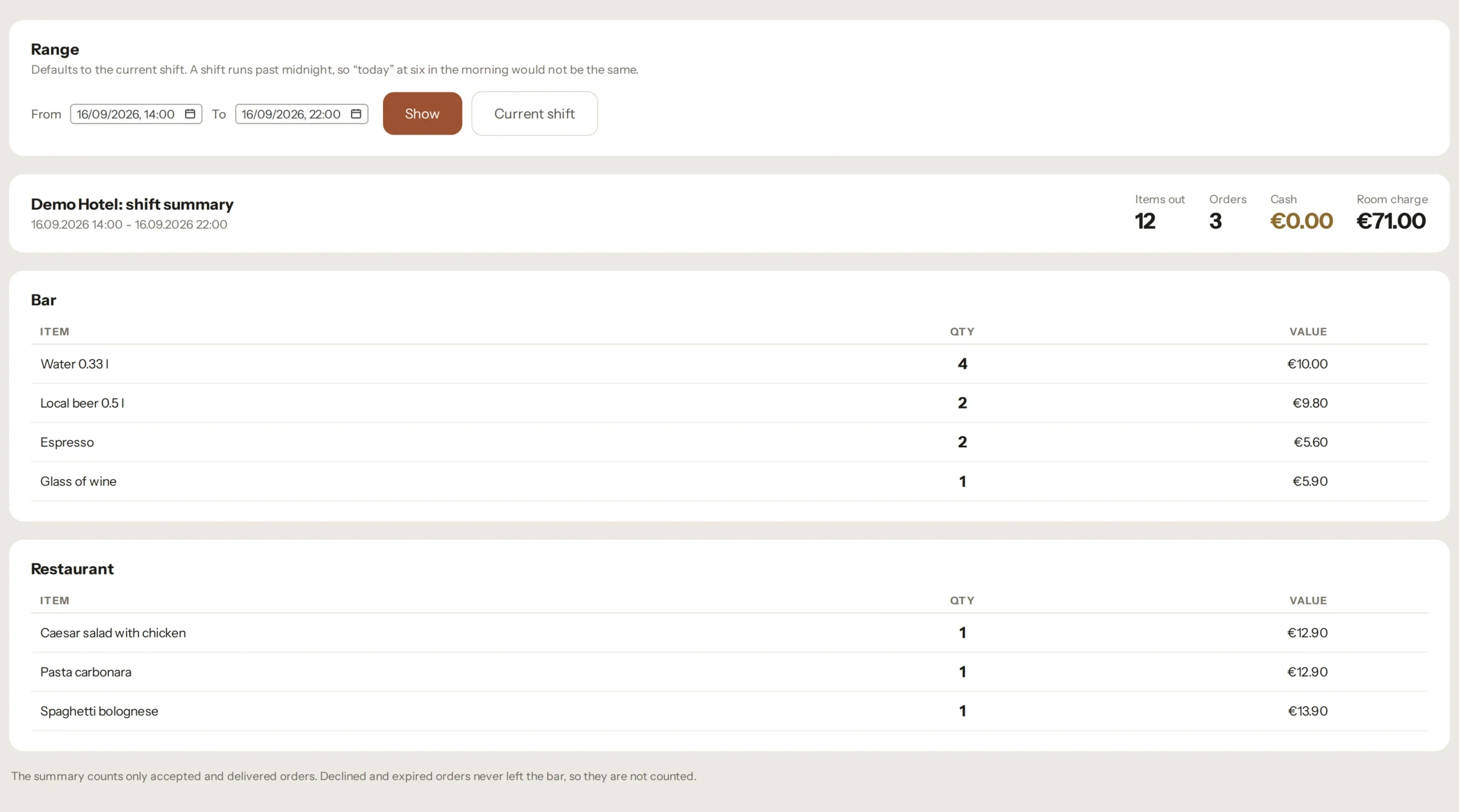
A shift summary for the bar, a daily and monthly report for the manager, and an export when accounting asks. Not a dashboard nobody opens — the two numbers a hotel actually uses.
How a rollout goes
For a hotel of forty to two hundred rooms, from your menu to the first real order is usually about two weeks. Most of that is printing and the pilot floor, not software.
Getting started includes a live presentation anywhere in Hungary and training for your staff.
- A demonstration. We show the system running with your own menu, on your own phone. Half an hour.
- Your menu goes in. You send a spreadsheet or your existing menu; we load it, set the outlets and the hours, and you check it.
- QR cards are printed. One per room, with your logo and the room number, on a sheet you can cut or send to a printer.
- The tablet is set up. One at the bar to start. A second for the kitchen if food and drinks go separately.
- One floor first. A pilot floor for a week, so the staff get used to the screen while the volume is small.
- The whole hotel. The remaining cards go out, and the reports start being worth reading.
Frequently asked
Does the guest have to install anything?
No. The code opens an ordinary web page. There is no app, no account, no password and no email address to give. That is the whole point — an app that has to be installed is an app that will not be installed for a two-night stay.
Does it have to run on our website or our servers?
No. We host it. Your IT department does not have to approve anything, install anything or open anything. If your website runs on WordPress and you want the menu on it as well, that is possible, but it is not required and it is not where the system lives.
Does it connect to our property management system?
Not in the first version, and we would rather say so plainly. Orders carry the room number and your staff post them to the room bill as they do today. The system is built so that a link to Opera, Mews or protel can be added later without changing how anything else works.
What happens if the tablet loses its connection?
A banner covers the whole screen as soon as two checks in a row fail — a silent screen that looks normal is worse than a screen that is switched off. Orders are not lost: they stay on the server and appear as soon as the connection returns, marked with how long they have been waiting. Anything nobody picks up within a set time is escalated to reception, who can confirm it from a browser.
How many languages can we offer?
As many as your guests need. The interface is translated by us; dish names and descriptions are translated by the hotel, because a machine translation of a local dish is how you end up serving something nobody ordered. Your staff always see the original name.
Can guests pay by card in the app?
Not today, by design. Orders go on the room bill, which means the hotel has no card data to protect and no payment provider to sign with. Cash on delivery can be switched on where it suits you.
Do we need new tablets?
Any tablet made in the last few years will do, and so will a spare laptop or the browser on the bar’s existing screen. If you would rather we supplied the hardware, say so and we will include it in the quote.
What does it cost?
It depends on the number of rooms and how many outlets serve them, so we quote per hotel rather than publish a price list. Ask for a proposal and you will get a figure, not a call-back to discuss a figure.
Ask for a demonstration
Tell us how many rooms you have and which bar or kitchen serves them, and we will come back with a proposal. If you would rather see it first, we will show the system running with your own menu: in person anywhere in Hungary, and on a call from anywhere else.
Room Service Now is a product of Not So Basic Media Kft., Budapest, Hungary.
Also from us: Food Ordering Now — online ordering for restaurants →