

For twenty years, the rules of online visibility were simple: rank on page one of Google, and customers find you. That game hasn’t disappeared — but it’s no longer the only game in town.
More and more people are skipping the search results page entirely. Instead of typing a query into Google and clicking through ten blue links, they’re asking ChatGPT, Claude, or Gemini a direct question — and getting a direct answer. No links to compare. No page two. Just one response, built from whichever sources the AI model trusts enough to cite.
If your business isn’t part of that answer, you’re invisible to an entire generation of searchers — no matter how well you rank on Google.
Search Is Splitting in Two
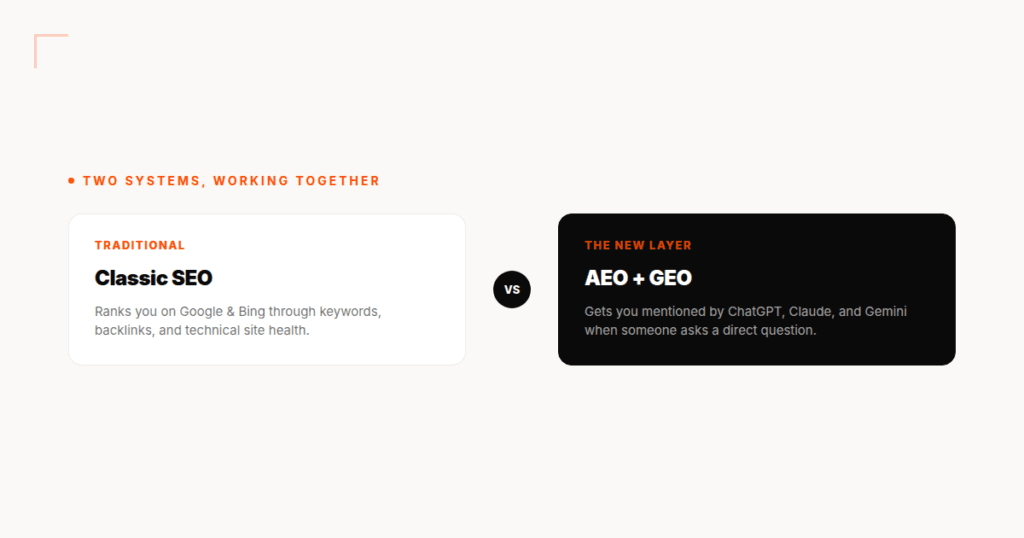
It helps to think of visibility today as two separate systems working side by side.
Traditional SEO still governs how you show up in Google, Bing, and other classic search engines. Keywords, backlinks, site speed, and technical health remain relevant here.
AEO (Answer Engine Optimization) and GEO (Generative Engine Optimization) govern something different: whether AI models mention your brand when someone asks a question in ChatGPT, Claude, Gemini, or Perplexity.
- AEO is about being the answer — structuring your content so an AI system can lift a clear, direct answer straight from your page.
- GEO is about being a trusted source — writing content authoritative and well-structured enough that generative AI models choose to reference it when building their answers.
Neither replaces classic SEO. Both sit on top of it.
Why This Matters Now, Not Later
Three things are happening at once, and together they explain why this shift can’t be ignored.
- AI-assisted search is growing fast. A meaningful and rising share of everyday questions — including commercial ones like “who’s a good web design agency in Budapest” — now go through an AI assistant before they ever reach a search engine.
- There’s no “page two” in an AI answer. Google gives you ten results and a chance to be seen even at position seven. An AI model typically gives one answer, built from a handful of sources. You’re either part of it, or you don’t exist in that conversation at all.
- Most competitors haven’t adapted yet. The businesses optimizing specifically for AEO and GEO today are still a small minority. That’s a real window — the same kind of window early SEO adopters had in the 2000s.
What Actually Changes in Practice
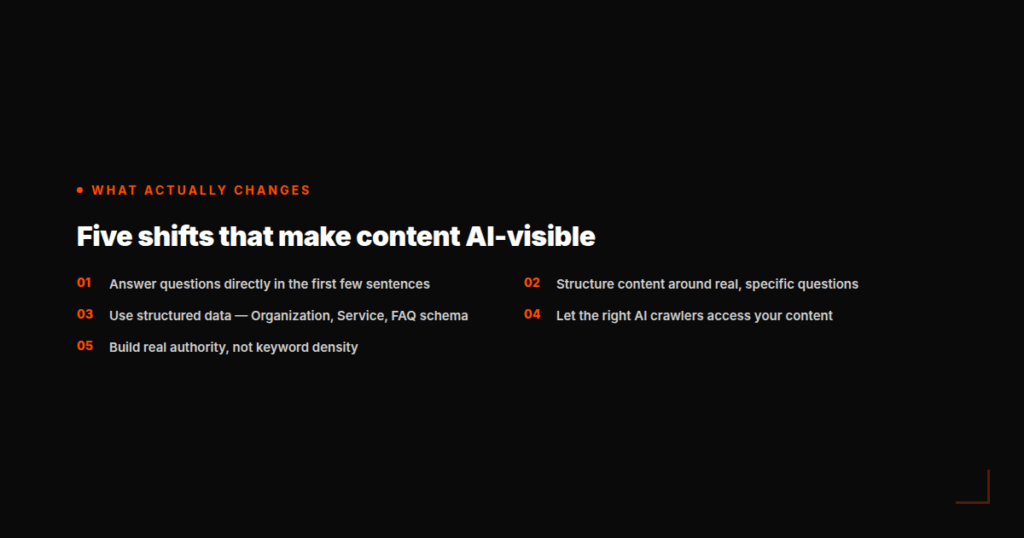
Optimizing for AI visibility isn’t a separate discipline you bolt on — it’s a shift in how you structure and write what you already have.
- Answer questions directly and early. AI models favor content that states a clear answer in the first few sentences, not buried three paragraphs down.
- Structure content around real questions. FAQ sections, clearly labeled headers, and one-idea-per-section writing are far easier for AI systems to extract and cite than long, unstructured paragraphs.
- Use structured data (schema markup). Machine-readable markup — Organization, Service, FAQ schema — helps AI systems understand exactly what your business does and confirms the facts they might otherwise have to guess.
- Let AI crawlers in — the right ones. Many sites accidentally block the very AI crawlers that could cite them, often through a default hosting or CDN setting nobody reviewed. It’s worth checking who’s actually allowed to access your content, and why.
- Build genuine authority, not keyword density. Generative models weigh trustworthiness heavily. Clear sourcing, real expertise, and consistent, accurate information across your site matter more here than they ever did for classic keyword-stuffed SEO.
The Bottom Line
Classic SEO isn’t dying — it’s just no longer the whole picture. The businesses that will be visible over the next few years are the ones treating AI answer engines as a distinct channel, worth structuring content for deliberately, rather than hoping their existing SEO work happens to translate.
The good news: none of this requires starting from scratch. It means auditing what you already have, and making it as easy as possible for both search engines and AI models to understand, trust, and cite you.