

Somewhere in the last year, a quiet shift happened. People stopped just asking AI assistants for information — they started asking them to do things. Book a table. Compare prices. Fill out a form. Buy the thing. And the tools are catching up fast: ChatGPT, Claude, and Gemini can now browse real websites, click real buttons, and complete real tasks on someone’s behalf.
This is called agentic browsing — an AI agent acting as a stand-in for a human visitor. And most websites, including plenty of well-designed, fast, SEO-optimized ones, have no idea it’s happening or whether they’re even usable by one.
Google Is Already Measuring This
If you’ve run your site through PageSpeed Insights recently, you may have noticed a new score sitting quietly next to Performance, Accessibility, SEO, and Best Practices: Agentic Browsing. It’s a direct signal that Google now treats “can an AI agent actually use this page” as a measurable quality dimension — not a future concern, a current one.
We checked our own site. It scored 2/2. That’s not a brag — it’s the whole point of this post: most sites haven’t even looked at this number yet, let alone optimized for it.
What Makes a Site Agent-Readable
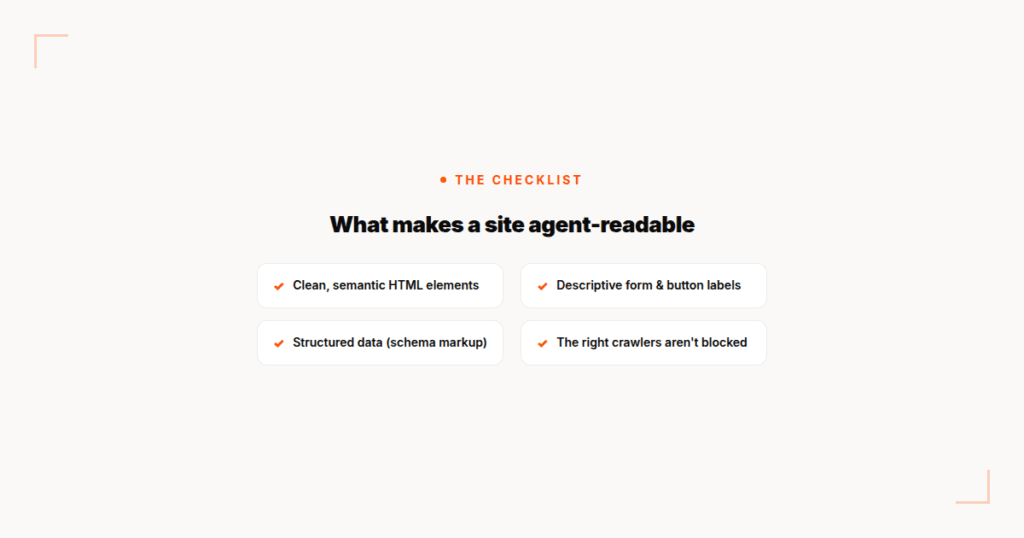
An AI agent navigating a website doesn’t see it the way a human does. It doesn’t recognize a button because it’s orange and says “Book Now” in a nice font — it needs the underlying structure to tell it clearly what that element is and what it does.
- Clean, semantic HTML — real
<button>and<form>elements, not divs styled to look like buttons with no underlying function an agent can detect. - Descriptive labels — form fields and buttons with clear, accessible labels (the same practice that helps screen readers helps AI agents too).
- Structured data — schema markup that tells any machine reader exactly what’s on the page: a product, a service, a reservation form, a price.
- No blocking of the wrong crawlers — a site that blindly blocks “AI bots” in robots.txt may be blocking the exact agents a customer sent to complete a booking on their behalf.
- Fast, stable loading — agents time out too. A slow, janky page fails an AI visitor the same way it frustrates a human one.
Notice something: almost every item on that list is also just good, modern web development practice. This isn’t a separate discipline bolted onto your site — it’s what happens when accessibility, clean code, and structured data are actually taken seriously.
Why This Matters Sooner Than You’d Think
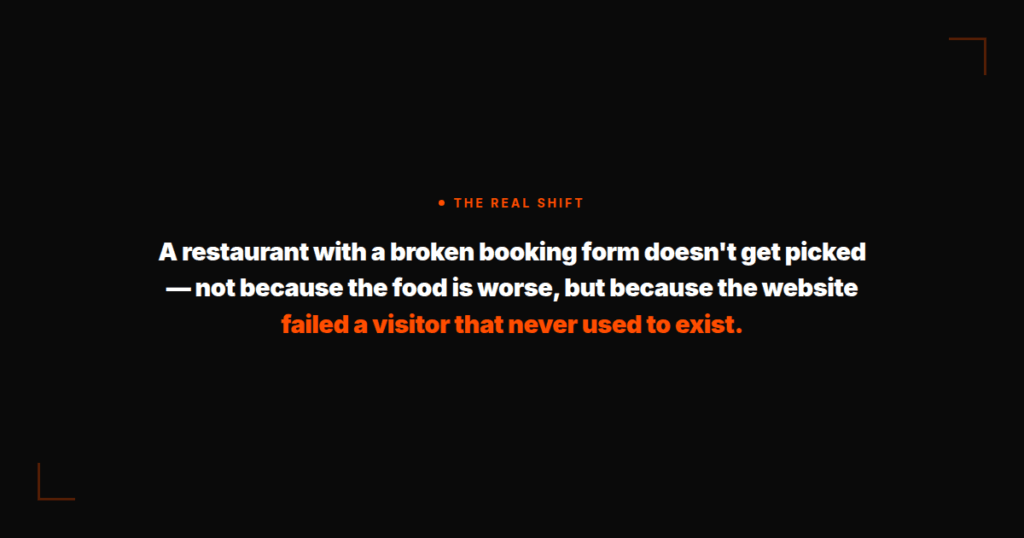
Picture someone telling their AI assistant: “Find me a table for four at a good restaurant downtown tonight and book it.” The agent doesn’t call the restaurant. It goes to websites, reads them, and tries to complete the booking directly. A restaurant with a broken reservation widget or a form an agent can’t parse simply doesn’t get picked — not because the food is worse, but because the website failed a visitor that never used to exist.
The same applies to booking a hotel room, requesting a quote, or checking whether a product is in stock. Every one of these is a task an AI agent can now attempt directly, on your site, without a human ever manually clicking through.
How to Check Where You Stand
Run your homepage through PageSpeed Insights and look for the Agentic Browsing score alongside the usual metrics. It’s new, it’s not heavily weighted yet, and it will only become more central to how these tools score a site over time — which makes now the cheapest moment to get ahead of it.
The Bottom Line
First it was ranking for Google. Then it was being cited by ChatGPT and Claude. Now it’s being usable by the AI agents acting on behalf of your actual customers. Each layer builds on the last — and none of them require starting over, just making sure the fundamentals (clean code, clear structure, real semantic markup) are actually in place.
Get a free audit of your website →
We’ll check your Agentic Browsing score along with everything else — and tell you exactly where you stand.