
If you’ve talked to a marketing agency in the last year, you’ve probably been handed a fresh alphabet soup: AEO, GEO, LLMO, AIO, “share of model,” “agentic search.” Some of it is presented like a countdown clock — as if your website will vanish from the internet unless you buy the new package by Friday.
It won’t. Let’s slow down and actually define these terms, so you can tell the difference between a real shift in how people find businesses online and a rebrand of the same invoice.
The glossary
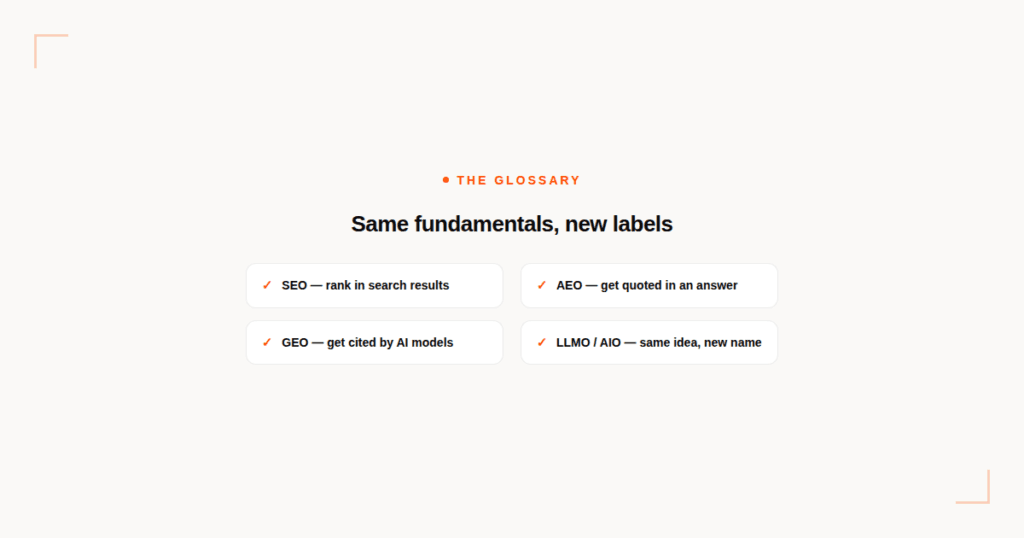
SEO. The original discipline: making your site easy for Google to crawl, understand, and rank — fast loading, clear content, good technical structure, credible links. This hasn’t gone anywhere. It’s still the foundation everything else sits on.
AEO — Answer Engine Optimization. The practice of structuring content so it gets pulled directly into an answer — a Google featured snippet, an AI Overview, a voice assistant response — instead of just a ranked link. The goal shifts from “get a click” to “get quoted.”
GEO — Generative Engine Optimization. The newer, narrower cousin of AEO, focused specifically on getting cited or recommended by generative AI tools like ChatGPT, Perplexity, Gemini, and Claude when someone asks them a question. Instead of a ranking position, the unit of success is a mention or citation inside a generated answer.
LLMO / AIO. Large Language Model Optimization and AI Optimization are two more labels vendors use for roughly the same thing as GEO. There isn’t a settled, universally agreed distinction between GEO, AEO, LLMO, and AIO — in practice, most agencies and tools use them interchangeably depending on which one sounds best in a pitch deck.
Structured data / schema markup. Small pieces of code added to a page that tell search engines and AI systems exactly what something is — a menu item, a business address, an opening hour, a review score — rather than making them guess from plain text. This has been standard good practice for years and matters for both traditional SEO and the newer AI-driven search.
AI Overviews (formerly SGE). The AI-generated summary that now appears above the normal results on Google for many searches, pulling from multiple sources and often reducing the number of people who click through to any single site.
Zero-click search. A search where the person gets their answer directly on the results page (or in a chat response) and never visits a website. This is a real and growing trend — it’s the reason “getting cited” is becoming as important as “ranking first.”
AI agents / agentic browsing. Software that can browse the web and take actions on a person’s behalf — comparing prices, filling out forms, booking things — rather than a human clicking through results themselves. Still early, but it’s part of why having clean, well-structured content matters more, not less.
Here’s the part most pitches leave out
Even the people who research this full-time admit there’s no fixed, agreed-upon line between AEO, GEO, and traditional SEO. The tactics overlap heavily — a fast, mobile-friendly, clearly written, well-structured site helps you show up in a normal Google search, a featured snippet, and a ChatGPT answer, all at the same time. Nobody has a stable formula for guaranteeing a spot inside an AI-generated answer, because there’s no fixed ranking to occupy in the first place — it changes response to response.
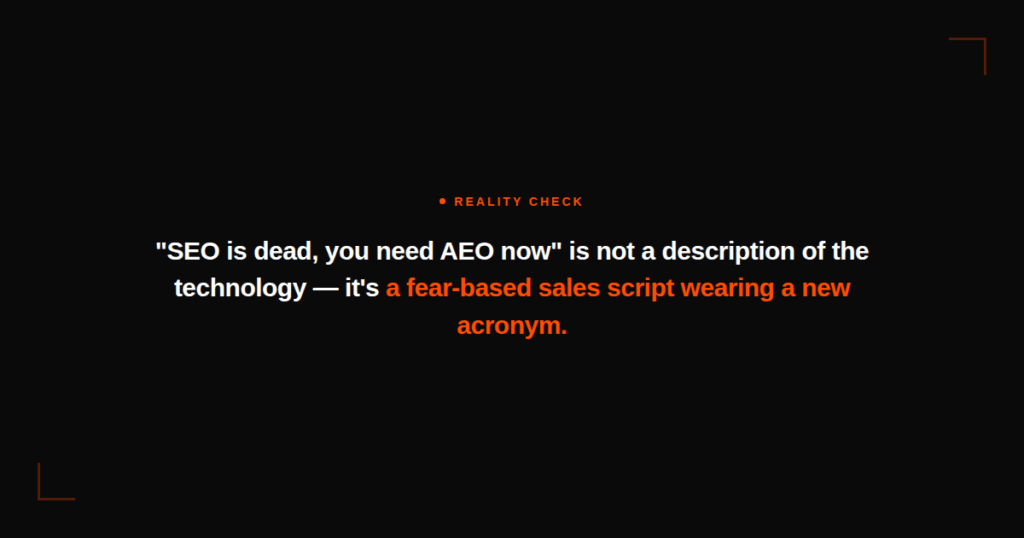
So when an agency’s pitch is “SEO is dead, you now legally need a separate AEO package, a GEO package, and an AI agent strategy, or you’ll disappear” — that’s not a description of the technology. That’s a fear-based sales script wearing a new acronym. The honest version is closer to: these are new surfaces where people find businesses, they reward mostly the same fundamentals as good SEO always has, and no one — not us, not them — can promise you a guaranteed spot inside an AI chatbot’s answer.
What actually moves the needle for a small or mid-sized business
- A fast, mobile-friendly, secure site — the same technical basics that mattered five years ago still matter now, arguably more.
- Clear, accurate, well-organized content that directly answers the questions your customers actually ask, instead of vague marketing copy.
- Structured data so search engines and AI tools can read your hours, menu, prices, and location without guessing.
- Consistent, accurate information about your business across your site, Google Business Profile, and social channels — this is part of what AI systems check before they trust a source enough to cite it.
None of that requires a separate, urgent, four-figure “AEO package.” It requires a site that’s built properly in the first place — which is the same thing we’ve been saying since before AEO was a word.
Not Sure Where Your Site Actually Stands?
If your current site is slow, thin on real content, or hasn’t been touched since before any of these terms existed, that’s worth fixing regardless of what you call the discipline.
No acronym required — just a straight answer about what your site needs.