

Most restaurants end up taking orders through somebody else’s app. It works, in the sense that food goes out and money comes in. But every order carries a fee, the guest belongs to the platform, and the restaurant spends years building a customer list it never gets to see.
Food Ordering Now is a WordPress plugin that moves ordering back onto your own site. Here is what that actually changes.
1. You keep the whole order
Delivery marketplaces charge a commission on every order. Depending on the country and the deal, that is somewhere between a fifth and a third of the bill — on food you bought, cooked and delivered.
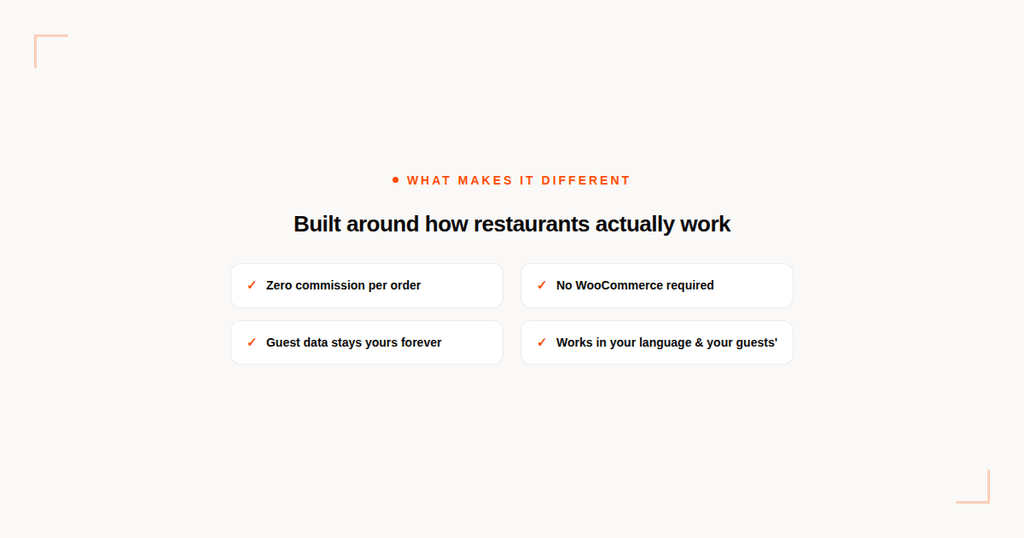
Food Ordering Now charges nothing per order. You pay for the plugin, and that is the end of it. A restaurant doing three hundred orders a month at twenty euros is handing a marketplace four figures every month for the privilege of taking its own orders.
The arithmetic is not subtle. It is the entire argument.
2. It does not need WooCommerce
Nearly every restaurant ordering plugin is built on top of WooCommerce. That means installing a full e-commerce platform, turning your dishes into products, and configuring a shop, a cart system, a tax engine and a checkout — for a business that sells burgers and coffee.
It also means every WooCommerce update is now your problem, and every WooCommerce security advisory is your Saturday.
Food Ordering Now is a standalone ordering system. Install it, add your menu, put one shortcode on a page. That page is your ordering page. Nothing else on your site changes, and nothing else needs maintaining.
If you already run WooCommerce for something else, it keeps working. The two do not interfere.
3. The guest is yours
This is the part restaurants notice late.
When an order comes through a marketplace, the marketplace gets the name, the phone number, the address and the order history. You get a receipt. Two years in, you have served thousands of people and cannot contact a single one of them.
When the order comes through your own site, all of it sits in your own database. You know who orders every Friday, what they order, and where they live. You can call them, email them, or put an offer in front of the ones who stopped coming.
It also lets you find out what actually brings people in. The plugin generates QR codes with a source tag built in — one for the tables, one for the window, one for the flyers. Each order then tells you which one it came from. Not an estimate; the actual count.
4. It is built around how a kitchen runs
Software written by people who have never worked a Saturday rush tends to show it. A few things in this plugin exist because they had to.
Opening hours, and a pause switch. Hours are set per day. On top of that there is one switch that stops new orders immediately, for the nights when the kitchen is buried and the last thing anyone needs is four more tickets.
A confirmation deadline. An order nobody accepts within the time you set is declined automatically, and the guest is told. Without that, a phone left in the office on a busy night means someone waits ninety minutes for food that was never coming — and never orders again.
A kitchen screen. Orders appear on their own, with a sound, on a tablet that stays open by the pass. Nobody refreshes anything. Staff get their own login that reaches orders and availability and nothing else, so the person on the pass cannot accidentally edit your website.
A busy signal. Set a threshold, and once that many orders are open at once, guests see that the kitchen is under pressure before they order, not after.
Delivery zones you draw. Zones can be a plain list with a fee each, or shapes you draw on a map. The guest drops a pin and the fee follows whichever zone it lands in. An address outside every zone is offered pickup instead of a delivery you cannot make.
5. It speaks your language, and your guest’s
Most ordering plugins are English-first, with a translation file if you are lucky and an admin panel that stays in English regardless.
Food Ordering Now ships complete in English, German, Hungarian, Croatian and Serbian — guest side and admin side both, every screen, every email, every button. The built-in guide is translated too. The language is a setting inside the plugin, separate from your site’s language, so a restaurant in Vienna can run an English site and still have its staff working in German.
Eight currencies are supported, each with the decimal handling it actually uses. Prices are stored internally as whole units, so cart totals, discounts and delivery fees stay exact instead of drifting by a cent.
For a restaurant in central Europe whose guests are not all locals, that is the difference between a system you hand to your staff and one you translate for them every shift.
If you are on GloriaFood, the clock is already running
Oracle bought GloriaFood in 2021 and is shutting it down on 30 April 2027. New signups closed in 2025, and the white-label partner programme went with them. More than 123,000 restaurants worldwide are still on the platform.
There is no migration tool, and Oracle is not building one. Every restaurant has to export its own menu, customer records and order history before the servers go offline. After that, the data is gone.
A menu is a few hours of work to rebuild by hand. A year of order history is not rebuildable at all. That is the part worth doing early rather than in the last month — and it is the reason to move once, onto something that sits on your own site, instead of again the next time a platform changes its mind.
What it does not do yet
Guests pay on delivery or at pickup, in cash or by card to the driver. Online card payment is in development and is not available today. We would rather say so plainly than have you find out after installing.
Try it with your own menu
The best way to judge ordering software is to run it on your real site with your real menu. The trial is seven days, the full plugin, and no card to start. If it does not fit, nothing happens and nothing is charged.
If your menu already exists as a file — a PDF, a spreadsheet, an export from another system — send it over before you start and we will convert it to a ready-to-import CSV at no charge, so the trial begins with your actual menu instead of a blank screen.