

Every WordPress site eventually hits the same wall: a plugin exists for almost everything, until it doesn’t. You need one specific process handled exactly the way your business actually works, and no combination of settings in three different plugins quite gets there. That gap is where custom plugin development starts making sense.
Here’s how to tell whether you’re actually at that point, and what building for it looks like when it’s done properly.
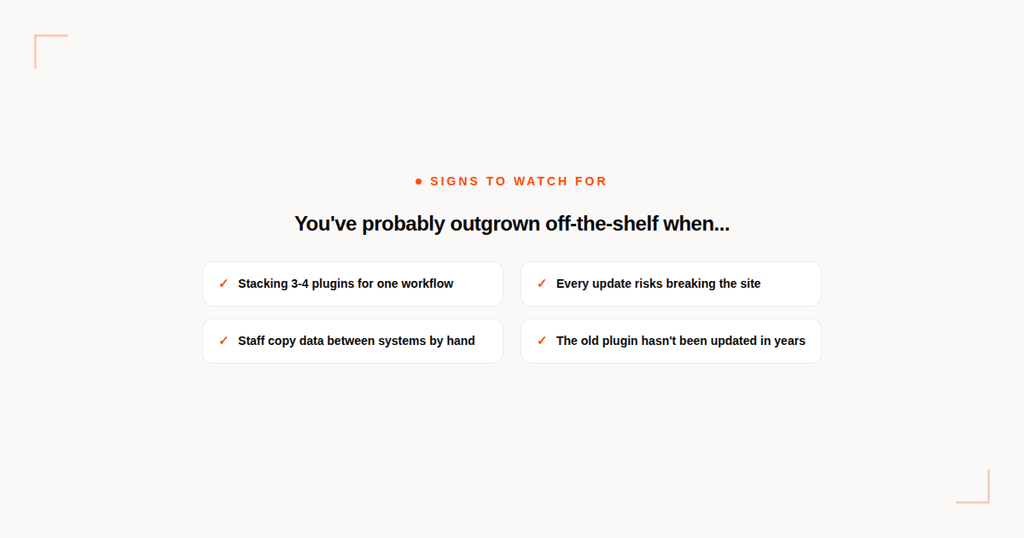
Signs you’ve outgrown the plugin directory
- You’re stacking three or four plugins to approximate one workflow, and it still breaks on edge cases.
- You’ve customized a general-purpose plugin so heavily that every update risks breaking your site.
- Staff are copying data by hand between WordPress and another system you already run.
- The plugin that used to handle this was abandoned by its developer and hasn’t been updated in years.
None of these are emergencies on their own. But together, they usually mean the site has outgrown what off-the-shelf software was built to handle, and every workaround from here adds more fragility, not less.
“Built” and “maintained” are not the same thing
A lot of custom WordPress code in the wild was written once, delivered, and never touched again. It works, until a WordPress core update or a PHP version bump quietly breaks it, and nobody notices for months because there’s no one watching it anymore. That’s not a code quality problem so much as a business model problem: nobody was ever responsible for keeping it working.
The distinction that actually matters isn’t “custom vs. off-the-shelf.” It’s whether anyone is still responsible for the code a year from now.
What this looks like as a real product: Food Ordering Now
One restaurant client needed online ordering that actually matched how their kitchen worked — delivery zones, scheduled orders, coupons, a dashboard the staff could use during a dinner rush without training. No existing plugin covered that combination cleanly. What started as a single client build turned into Food Ordering Now, a licensed WordPress plugin that turns a restaurant site into a full ordering system — menu, cart, checkout, delivery zones, coupons, scheduled orders, and an order dashboard — with no per-order commission taken.
That’s the version of this where custom development pays for itself twice: once for the original client, and again every time someone else licenses it instead of building the same thing from scratch.
What to expect if you go this route
- The conversation starts with the process, not the code. What has to happen, who does it, and where it currently breaks — a good chunk of these conversations end with a smaller, cheaper build than the client expected.
- Standard WordPress hooks and APIs, no core edits. That’s what lets another developer open the code two years from now without guessing what was changed.
- Documentation ships with it — a written boundary between what the plugin owns and what the theme owns. You keep the code and the data either way.
- Maintenance is part of the offer, not something you find out you need after the first broken update.
Not every gap needs a custom plugin — sometimes the honest answer is that an existing plugin already does the job, just not the way you first tried to configure it. That’s worth saying upfront, before any code gets written.
If your site has hit a wall like this, tell us what it needs to do and we’ll tell you honestly whether a plugin is the right answer.